
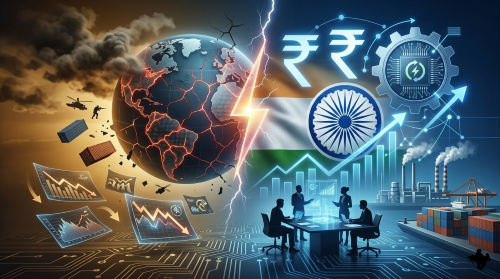
Geopolitical Tensions and India: Economic and Sectoral Implications in a Changing World Order
Written by: Surendra Jauhari – SEBI Registered Investment Advisor,
INA000021474
Global geopolitics is entering into a volatile phase. As US-Israel
and Iran conflicts, increasing polarization among global powers, exaggerating uncertainty
across energy markets, global trade and financial system.
For India, it is a structural challenge to energy security &
economic growth.
While India known as world’s largest growing economy, such events
will create short-term volatility is inevitable, but fundamental strength
provide significant resilience to Indian economy.
Short-Term View:
The OIL & Logistics Squeeze
These ongoing geo-political events can create two major critical
areas: energy prices and trade routes.
Energy Bill
50% of Indian crude oil coming from Gulf, where 40% is from Strait
of Hormuz, any disruptions push brent prices towards $90 - $100 range. Already
up from $66.46 from 12 Feb, 2026 to $87.44 as on 6th March, 2026.
Logistic Inflation
Shipping insurance premium for the Arabian Sea have spiked, which
again going to make expensive vegetables to iPhones.
Other Short-Term Impacts
· Higher
Fuel Prices
· Rising Transportation
Costs
· Inflation
in Food and Manufacturing
· Pressure
on Indian Rupee and Fiscal Deficit
Oil prices rising even $10-$20 per barrel can significantly widen
the current account deficit (CAD).
Due to rising crude oil prices and global uncertainty has caused
sharp corrections in Indian market.
Short-term market behaviour often includes:
·
FII Outflows
·
Defensive Sector Rotation
·
Increase Demand for Gold
India can face trade and export disruptions such as agricultural products
and engineering goods.
Also having large diaspora in the Gulf region, may face:
·
Remittances
·
Labor Mobility
·
Bilateral Trade
The Long-Term View
Strategic Decoupling and Autonomy
Despite short-term shocks, India strategic position is going to be
strengthen overtime.
Supply Chain Diversification
India benefits from:
·
China+1 Strategy
·
Production Linked Incentive (PLI) Schemes
& Make in India
·
Growing Domestic Market
This will create India as a global manufacturing HUB. India as
seen as alternative to China and this shift of manufacturing (Electronics,
Semi-Conductor) from volatile regions to the India as “Safe Haven” country.
The Russia-India Oil Pivot (March 2026)
As India clearly stated that Russia will remain the largest crude
oil supplier, on March 07th 2026 Indian Govt. stated that India does
not need any one’s permission, counter the US statement of 30-day waiver.
While India has reduced below 20% Russian Oil in early January
2026 to satisfy trade deals, The Strait of Hormuz blocked has forced a
strategic reversal. Gulf supplier is now under threat making Russian oil a non-negotiable
life time for India.
Accelerated Green Pivot
High oil prices act as catalyst for India BESS (Battery Storage)
& EV transition. The more expensive oil gets, the faster the ROI on a
solar-EV setup becomes.
Geo-Political Risk Score Card
The impact on crude prices of $120 per barrel may bleed some
sectors while others act as “War Shield”.
Table
|
Sector |
Risk
Level |
Impact
high Oil at $120/World War |
|
Aviation |
🔴 Extreme |
Fuel is 40% of cost and if oil reached $120, then margin will be
vanished, international routes face closure/rerouting. |
|
Paints and chemicals |
🔴 High |
Crude derivatives constitute 40%-60% of input costs which
directly squeeze the operating margin |
|
Auto |
🔴High |
Higher fuel oil prices degrade consumer sentiments; high
logistic costs may increase car prices. |
|
OMCs IOCL/BPCL SEBI Registered Know How Healthy Your Portfolio Really IsUpload your mutual fund or stock portfolio and receive a free portfolio dashboard. Unlock a comprehensive audit with portfolio diagnostics, risk analysis, overlap detection, and detailed educational insights. Free portfolio health check · No obligation |
🟠 Moderate |
Downstream due to refining and marketing |
|
IT Services |
🟠 Moderate |
A weak Rupee (₹92+) boosts USD revenues but AI-led demand is
\"geography-blind.\" |
|
ONGC |
💎 Beneficiary |
Gains directly from higher global oil prices (higher
realizations). They are directly involved in the exploration and production
(E&P) of crude oil |
|
Defence (HAL/BEL) |
💎 Beneficiary |
Global war drives local orders. Record ₹6.81 Lakh Cr budget
provides visibility. |
The “World War” Shield
Why India is protected, India possesses multiple layer of
protection that most nations lack:
Macro-Economic Buffer
Holding more than $700 Billion Forex Reserves, gives RBI strengthen
to defend the Rupee against panic-driven capital flight.
Domestic Consumption Engine
India’s 60% of GDP is driven by domestic demand, which is unlikely
with export dependent nation (like Germany or Vietnam), best part is even global
trade stops, the internal market remains live.
Defence Indigenization
65% of India’s military equipment is now made domestically and moving
away from being one of the world\'s largest importers to a net exporter.
Balanced Global Diplomacy
India maintains diplomatic relations with multiple global powers. Even
during the geopolitical conflicts Indian will maintain the trade due to its
strategic neutrality stance.
My Perception: The \"Fortress India\" Reality
Global growth moderates at 2.7%, India is estimated to grow at 6.6%-7%
GDP growth which again tends to lead other major economies.
India shifts from traditional globalization to strategic globalization,
focusing majority on security first and this neutrality stance with other economies
like dealing with all as friend has positioned at greatest protection.
Food Sovereignty
India is being net food exporter other than the Gulf or UK. India can
feed up to 1.4 billion people without relying on global shipping.
The Neutrality Dividend
India being stay out of direct military alliances, remains the
large economy and trade with both the west and the east (Russia/Iran).
Financial War Chest
The $700 billion forex reserves, RBI can defend the Rupee for at
least 12-18 month of total global chaos.
India as the Stability HUB
Energy from Russia: The “Value” Play
Trade with the West: The “Growth” Play
Security in the Indo-Pacific: The “Stability” Play
In a World War scenario, India\'s greatest asset is its Neutrality
and its Domestic Demand. While export-led economies would collapse,
India’s internal market keeps its heart beating.
Investment Perspective for Indian Investors
In such an environment, portfolio positioning becomes critical.
|
Key
strategic themes |
|
Higher crude prices affect multiple sectors
|
Inflation
Pressure |
|
This can lead to higher consumer inflation in India.
Discount Advantage
Western countries have started avoiding Russian oil due to sanctions,
then Russia started selling crude at lower prices to countries like India and China.
Due to this discount advantage Indian can reduce import costs compared to other
countries. Despite the pressure from US, Russia still a major supplier at $15
to $20 per barrel at discounted rate like countries India and helping to manage
energy costs. It shows stronger India-Russia energy partnership and this
long-term contract may ensure stable and discounted supply from Russia to
India.
How High oil prices accelerate alternative investments in India
|
Investments in Alternative Energy |
|
India is already aggressively expanding in these areas.
Sector-Wise Impact in India for investments
|
Positive
Sectors |
Neutral
Sectors |
Vulnerable
Sectors |
|
Defence Energy Exploration Renewables Gold Domestic Manufacturing and Consumption These sectors benefit during geopolitical instability. |
Banking Infrastructure FMCG
Domestic demand supports these sectors. |
Aviation Chemicals Logistics Paint Companies Tyre Companies These sectors heavily rely on crude oil derivatives. |
Investment Perspective
During geopolitical crises, portfolio strategy should focus on:
- Large
cap companies
- Gold
allocation
- Energy
sector exposure
- Defence
manufacturing
- Domestic
consumption themes
Avoid excessive exposure to highly cyclical sectors dependent on
global trade.
Conclusion
Geopolitical conflicts are creating uncertainty but also its
reshaping global power structure.
In short,
India may face challenges due to this ongoing uncertainty and may impact with
higher crude oil costs, market volatility and trade disruptions.
However,
India’s strong domestic economy, diversified diplomatic relations, and growing manufacturing
eco-system placed it to even stronger in the long-term.
If global
tensions keep continue then it would reshape the world order and India would
evolve as one of the important strategic economic centres for the next
decade.
Disclosure & Disclaimer
- Educational Purpose Only: The
data provided like charts and analysis is for purely educational and
information purposes and should not under any circumstances be considered
as professional financial advice or a recommendation for buying/selling
any financial instrument.
- SEBI Registered Investment Advisor:
Wealth+ Advisers(www.wealthplys.com) INA000021474
·
Registration granted by
SEBI, membership of BASL, and certification from NISM in no way guarantee
performance of the intermediary or provide any assurance of returns to
investors.
- Securities market investment involves
market risks. All the relevant documents should be read cautiously before
investing.
- Risk of Loss: The
values of investment may fluctuate both positively and negatively. Past
performance does not in any way indicate future results. The level of
risks is also qualitative data interpreted on the basis of historical
information.
- Accuracy of Data: Though
utmost care has been taken for the accuracy of the information provided,
the market scenario is dynamic. The user is advised to check the facts
through authentic channels, such as SEBI, RBI, or Ministry of Finance,
before taking any investment decision.