
Author: Surendra Jauhari
SEBI Registered Investment Advisor - INA000021474
The Court Did What Diplomacy Couldn't
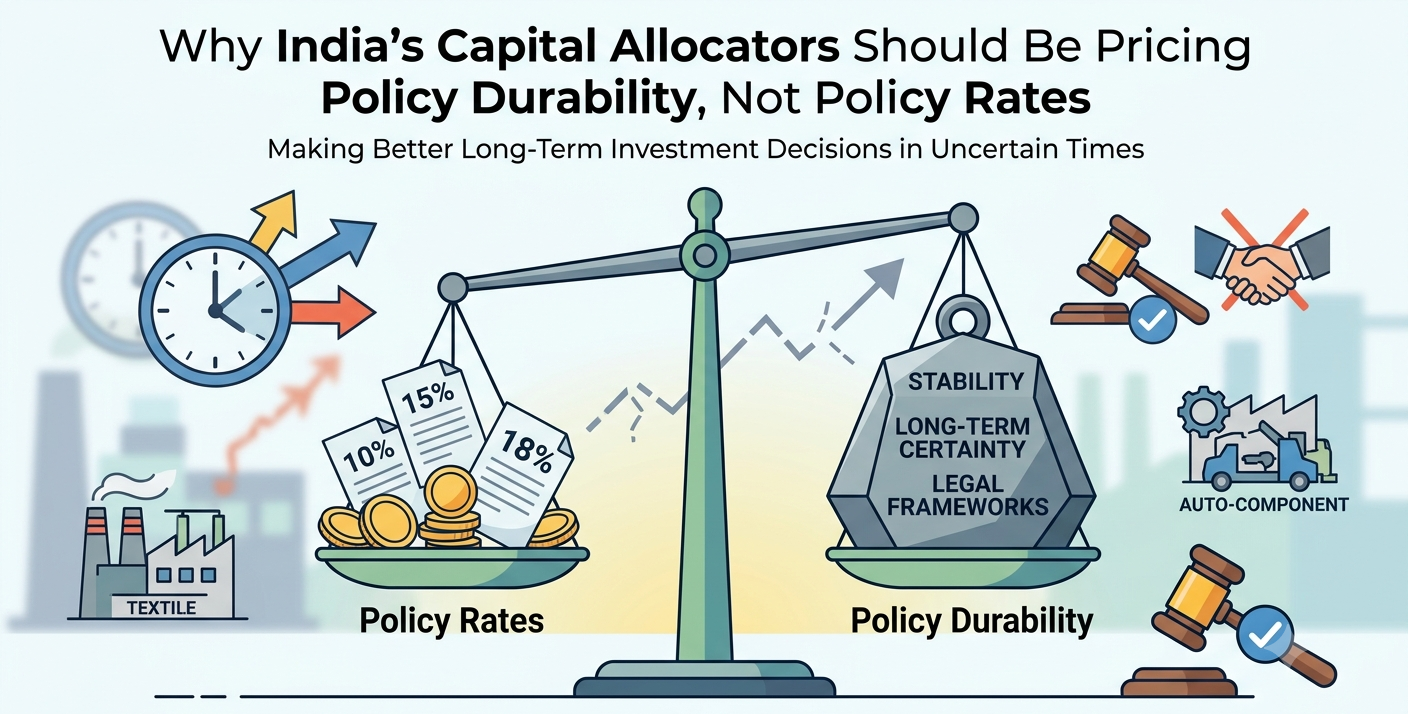
Why India's capital allocators should be pricing policy durability, not policy rates
On February 7 2026 Commerce Minister Piyush Goyal made an announcement. He told the press that India and the US had agreed on a tariff rate. India's tariff on exports to the US would go down from 50% to 18%. This was a win for India. The White House and India's Press Information Bureau (PIB) confirmed it.
Just 13 days later it was all undone. The US Supreme Court made a ruling in a case called Learning Resources, Inc. V. Trump. The court said that the International Emergency Economic Powers Act did not allow for tariffs. So, the 18% tariff rate was no longer valid.
On February 24 the US administration came up with a plan. They would impose a 10% global surcharge on imports. This was under Section 122 of the Trade Act of 1974. India got a rate but it did not do anything to earn it. It could do nothing to keep it.
We think this is a deal. It's not about the tariff rate. It's about how stable the rate's. India's goods exports to the US are huge. They were $87 billion in the last financial year. The US is India's export market.
These exports are not any exports. They are from industries like auto components, textiles and apparel. These industries are growing fast. Auto components exports grew from $4.1 billion to $7.3 billion in a few years. Textiles and apparel exports to the US were $10.8 billion year.
The problem is that the tariff rate keeps changing. It's like there are three clocks ticking. One clock is the Section 122 statute, which expires in 150 days. Another clock is the Court of International Trade which ruled that Section 122 is unlawful. The third clock is the US Trade Representative (USTR) which is investigating India's trade practices.
These clocks are not synchronized. They are not under India's control. India's capital allocators need to think about this. They need to price in the durability of the policy not the rate.
Arvind Ltd, a textile company understood this. They reported earnings but paused their capital expenditure. They did not know what the tariff rate would be in the future. They said they would resume their plans when the uncertainty went away.
Know How Healthy Your Portfolio Really Is
Upload your mutual fund or stock portfolio and receive a free portfolio dashboard. Unlock a comprehensive audit with portfolio diagnostics, risk analysis, overlap detection, and detailed educational insights.
This is not about economics. It's about real options theory. When the future is uncertain it's rational to wait. You don't want to make a mistake.
Some people might say that the impact on India's economy is not big. They might say that the GDP hit is 30 basis points.. This is not the point. The point is that the uncertainty is affecting capital allocation decisions.
India Ratings downgraded its sector outlook on textiles. Manufacturing-themed mutual fund flows also changed suddenly. This is not an economy absorbing a shock smoothly. This is capital flinching.
So what do you do? You start thinking about policy durability. You stop treating "what's the tariff rate”, as the question that matters. You start treating "how stable is whatever rate currently exists" as the question that matters. These are not the question.
A signed trade agreement and a Federal Circuit ruling are two things. They are not connected. Anyone who thinks they are is not thinking clearly.
We do not think this thesis requires anyone to guess where the rate will end up at 10%, 15% or whatever the next announcement says.
We think it asks for something simple and frankly more helpful: include the uncertainty itself in how you price long-term investment commitments in these sectors instead of waiting for a number that has changed many times to finally stay the same.
Arvind's management team said they will provide guidance once things become more stable.
That is not management being cautious with their words.
That is the straightforward piece of guidance we have seen from any management team during this time and it makes us wonder:
is the money being invested in these sectors priced as if stability already exists or as if it does not?
The question is really, about how the capital being invested is priced.
Is it priced for stability or uncertainty?
That is the question that matters when it comes to investing in these sectors today.
Disclaimer: I am a SEBI Registered Investment Adviser (RIA). This post is for informational and educational purposes only and does not constitute investment advice, financial advice, or a recommendation to buy or sell any securities. All investments involve risk, including the loss of principal.
Investment in securities market are subject to market risks. Read all the related documents carefully before investing.
Registration granted by SEBI, membership of BASL (in case of IAs) and certification from NISM in no way guarantee performance of the intermediary or provide any assurance of returns to investors.