
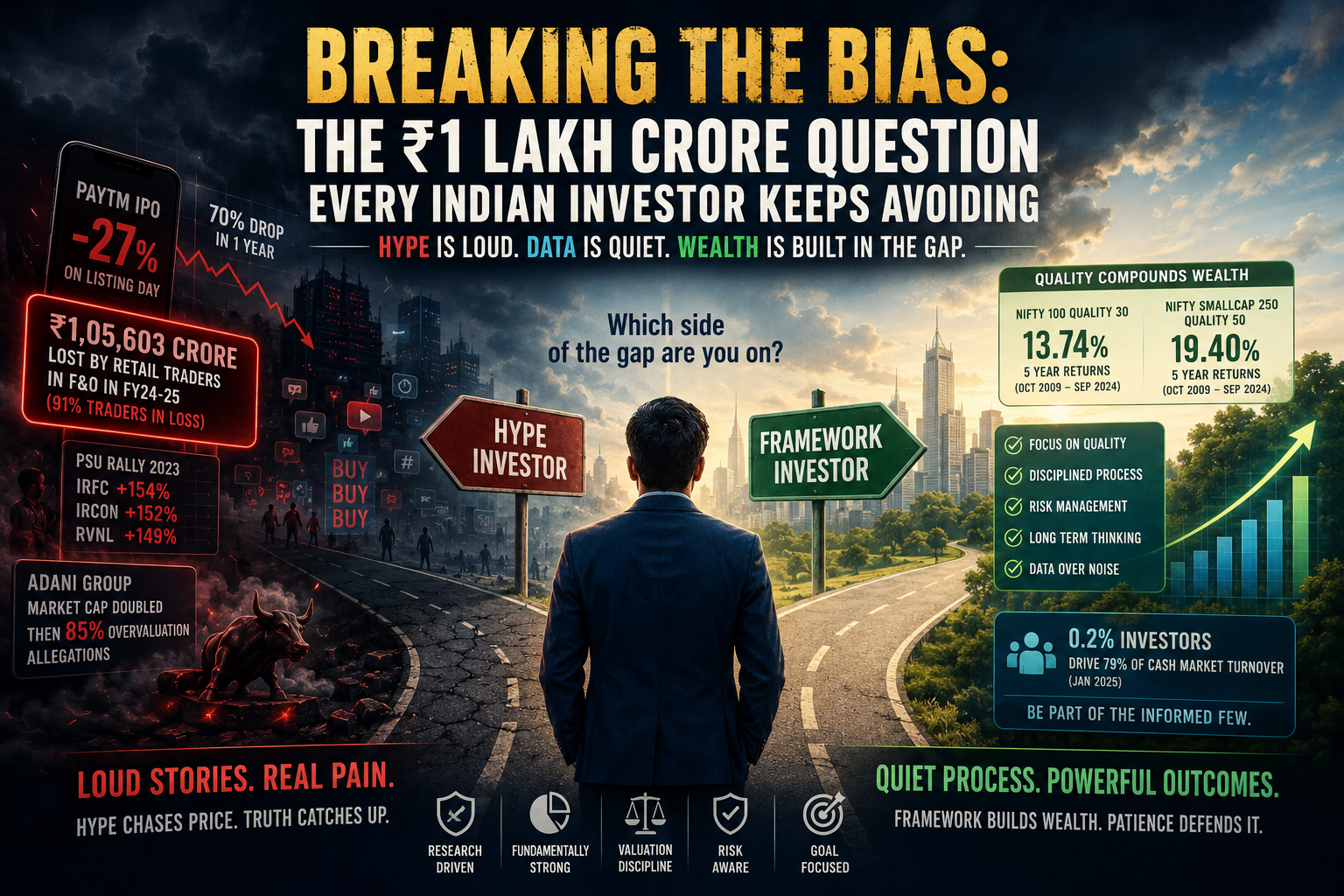
Why do people get so excited about equity markets and what do the numbers say about Indian investors who never fall for the hype?
On November 18 2021 Paytm rang the opening bell on India's ever Initial Public Offering. For an hour it felt like the country’s fintech coming-of-age moment. Big names like Masayoshi Son and Alibaba had backed Paytm. The company raised $2.5 billion, which was the largest in Indian capital markets history at that time. By the time the closing bell rang the stock had fallen by 27 percent.
Paytm lost 70 percent of its Initial Public Offering value within a year. The big gap in valuation that Macquarie had already pointed out was clear. Paytm was valued at 26 times its estimated sales for the year 2023. There was no path to making a profit. The company had losses of ₹2,942 Crore in the year 2020 ₹1,701 Crore in 2021.
All this was obvious even before retail investors started bidding. Nikhil Kamath, co-founder of Zerodha said it simply: there was excitement around Initial Public Offerings. Institutional investors were more careful than investors, who were losing money. The stock market was a place for them. The value of Paytm stock kept falling. The company’s losses were very high. Investors were worried about their money. The stock market was not kind to investors.
We tell this story because it is the version of a pattern that recurs across equity markets with almost mechanical regularity. A narrative forms, like the arrival of fintech or a Public Sector Undertaking renaissance. Capital chases the narrative. Somewhere between the chasing and the correction the framework of earnings visibility, valuation multiples and balance sheet quality gets left behind entirely.
The losses are not stories. They are structural. Is Paytm an outlier, an Initial Public Offering in an otherwise disciplined market? SEBIs own numbers say no. In its July 2025 study the regulator found that individual traders in the equity derivatives segment lost ₹1,05,603 crore in FY24-25. This was a 41 percent jump over the ₹74,812 crore lost the year before after transaction costs. Over 91 percent of traders were in the red.
This is not a market of a gambler. This is a market where nine out of ten participants in a product are demonstrably losing money year after year in numbers enough that SEBI now mandates brokers to disclose the statistic at login.
The hype does not come from everyone. NSEs Market Pulse data shows that over 72 percent of investors in the cash segment account for 0.4 percent of turnover while 75 percent of options traders contribute a mere 2.4 percent of premium turnover. By January 2025, 79 percent of the ₹22 lakh crore traded in the cash segment that month came from 0.2 percent of investors. The hyperactive hype-chasing cohort driving derivatives losses and headline volatility is numerically tiny. It is simply loud, disproportionately visible and disproportionately quoted.
The Public Sector Undertaking Rally Was Real Until the Fundamentals Caught Up. Consider 2023, when IRFC surged 154 percent, Ircon International climbed 152 percent, Rvnl gained 149 percent all riding a narrative of government capex, high-speed rail ambition and a swelling defence order book. Then the close examination started. By September 2024 a local brokerage firm was warning about drops in stocks like Mazagon Dock Shipbuilders, Bharat Dynamics, Cochin Shipyard, HAL, RailTel, RVNL and IRFC. These were the stocks that had led the rally. They pointed out a difference between the market value and the actual worth of these companies.
Small-Caps: A Regulator Warns. Capital Keeps Flowing Anyway. Rewind to March 11 2024. SEBIs then chairperson, Madhabi Puri Buch told the market plainly that there were "pockets of froth" in midcap stocks with valuation parameters in some segments "off the charts and not supported by fundamentals”. She called it without qualification, " exuberance." This was not a caution. It came after small cap mutual fund inflows had already doubled to over ₹41,000 crore in 2023 prompting SEBI to mandate stress tests on small cap and midcap funds to determine redemption-liquidation timelines.
Know How Healthy Your Portfolio Really Is
Upload your mutual fund or stock portfolio and receive a free portfolio dashboard. Unlock a comprehensive audit with portfolio diagnostics, risk analysis, overlap detection, and detailed educational insights.
When Even Scale Isn't Proof of Verification. If small-caps show that hype persists despite warnings Adani Groups 2023 episode shows that hype can survive at the possible scale. Between 2021 and 2022 the conglomerates market capitalization doubled from ₹9.62 lakh crore to ₹18.13 lakh crore with a ₹20,000 crore Further Public Offering in the works. Then on January 24 2023 Hindenburg Research published a report alleging "stock manipulation and accounting fraud" claiming seven listed Adani companies were overvalued by 85 percent on fundamentals carrying debt with shares pledged as loan collateral. Group market capitalization fell from $227.78 billion to $80.67 billion within five weeks a $140.1 billion wipeout. The group lost ₹85,760 crore in a single day and a cumulative ₹3.86 lakh crore within two trading sessions. The FPO was cancelled. Margin calls on pledged shares intensified the collapse.
WHO’s Actually Driving the Narrative? None of this happens in a vacuum. Indias demat account base surged from 40 million in March 2020 to over 140 million by December 2023 among Gen Z and Millennials against a backdrop of over 3,500 YouTube channels dedicated to financial content as of 2024. A study of 395 Indian Initial Public Offerings between 2014 and 2024 found that finfluencer-backed issues experienced under-pricing and initial returns than analyst-recommended ones.
A Counterargument Worth Taking. To be fair to the trend-followers: momentum is not the same as hype at not in its academic form. Jegadeesh and Titman’s 1993 finding that a disciplined "buy winners, sell losers" strategy produces risk-adjusted excess returns has been replicated across markets and asset classes for over thirty years. A framework built around rejecting trend-following risks discarding a factor simply because its retail-level expression looks, superficially like undisciplined hype-chasing.
So, What Actually Distinguishes a Framework, from a Story?
A disciplined investment framework emphasizes quality, valuation, diversification, and risk management.
If momentum is real and smart money is mixed with money what makes a framework investor different from a hype investor is not that they both have strong beliefs about the market. It is what they base their investment beliefs on. Consider the quality factor of framework investors and hype investors. Over five years from October 2009 to September 2024 the Nifty100 Quality 30 gave a 13.74 percent return while the regular Nifty 100 gave a 13.34 percent return. This was an advantage when the market was going up.
For the Nifty Small cap 250 the Quality 50 variant gave a 19.40 percent return compared to 13.30 percent for the index. When the main index had returns in 20 out of 21 quarters the Quality 50 variant fell less. The real value of a framework investor is not in making a lot of money when the market is going up. It is in what happens when the market is going down the part of the cycle that people do not usually talk about because keeping your money safe is not something that people share on media like a 150 percent return on a PSU stock.
Every time whether it is Paytm the PSU rally, the small-cap cycle or Adani the same thing happens: the price goes up fast. Then the truth catches up and it hurts. The only question left for any investor reading this is if they are willing to learn the way which side of the gap, they are on the framework investor side or the hype investor side. The choice is between being a framework investor and being a hype investor.
Investment in securities market are subject to market risks. Read all the related documents carefully before investing.
Registration granted by SEBI, membership of BASL (in case of IAs) and certification from NISM in no way guarantee performance of the intermediary or provide any assurance of returns to investors.
This post is for educational and informational purposes only and should not be construed as investment advice, a recommendation, or a solicitation to buy or sell any securities. Views expressed are based on publicly available information and the author's analysis at the time of writing. Investments in securities are subject to market risks. Please consult your SEBI-registered Investment Adviser before making any investment decision.