
Survival of the Fittest: Why Your Portfolio Needs "Rubber Balls," Not "Wet Sponges"
Author: Surendra Jauhari
As
geo political issues are escalating it is natural tendency to feel panicked
when “everything is down”.
When
news headlines scream for war, supply chain disruptions and rising inflation,
the immediate human reaction is to freeze everything and hold on, hoping for
the rapid recovery of their down portfolio.
However,
during the crash of holding portfolio requires cold and rationale assessment of
what you holding. Critical difference of high quality (fundamental) stock and
weak stock (non-fundamental) should be taking into the consideration and this
is not the question of how fast they fall, but their likelihood of recovery.
During
the crisis and in this current environment, kept holding of weak fundamental
stocks is not just uncomfortable, it can lead to severe underperformance or
permanent capital loss.
Let’s
understand with the example of Sales employee in an organisation, their performance
reward them for incentive, not for those who underperformed. Same way people
buy weak companies, it includes weak PSU stocks also on the basis of news
headlines or hope of future performance. Buy companies those who are performing
in all parameters, those fundamental companies have inherited strength to
perform and come back even they down due to crisis.
Key
Talking Points
The
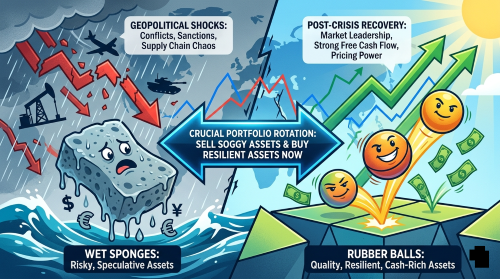
“Rubber Ball” vs “Wet Sponge”
Panic
selling impacts everything during the crisis and hit the market badly. Yet high
quality fundamental companies and weak companies act very differently after
they hit the ground.
Fundamental/Moat
Company (“Rubber Ball”)
These
companies have strong fundamental, they are the leaders in the market with strong
cash flows, low or no debt, high margin growth and a “moat” (brand, technology
and pricing power). Whenever market crash either these stocks get thrown down
hard or may be lass down (price down), have the inherited strength to
comeback/bounce back to their previous highs quickly.
Let’s
take the example of Bajaj Finance, in March 2020 it was trading between
4500-4900 and got hit down to 1780 in March 2020 due to covid panic selling. By
14th Dec 2020 it has made
previous March high in just 298 days, 15th Dec 2020 was the record
date for all time high, stock closed at 5112, marking a full recovery and a new
high.
Weak
Companies (“Wet Sponge”)
These
are the companies which do not have fundamental strong, with no moat, high debt
and low margins. When these companies hit and get thrown down, either they do small
recovery or stay there. In many cases, they never come back to their previous
high, because crisis has broken their fragile business model.
The
Goal: Never hold
wet sponge in your portfolio, and expect it to fly.
The
“Recovery Time” Difference (Crucial)
Holding
weak stock with the hope of “break-even, can be biggest mistake during the
downturn market.
Study
of historical data shows that high quality stock and weak stock may fall by
similar percentage during the crisis and panic selling but they do not have
similar recovery. High quality companies may recover between 150 days to 300
days but weak companies may take more than 950 days or may take more years to
recover, if they do well, sometimes not possible to recover.
The
point is by holding weak companies and waiting for the market to improve, you
are potentially losing your capital and killing your time. Due to this mindset,
you even locking up your capital for years and missing those who have faster
recovery and perform better.
Why
weak companies may not recover after geo-political shocks
The
simple reasons, when tensions escalates and it hits crisis like a war,
disrupting oil, sanctions creating inflation, oil imports at higher prices and depreciating
currency due to high cost of imports.
Strong
Companies will
sustain due to cash surplus, pricing power and moats to absorb these costs.
Weak
Companies will
struggle with high input prices, high debt and low margins. They either face
insolvency or need to raise capital at low prices, which wipes out existing
shareholders.
Companies
may struggle to make interest payments due to the crisis and low
demand for their products, while also lacking the pricing power to
pass high input costs on to consumers.
Know How Healthy Your Portfolio Really Is
Upload your mutual fund or stock portfolio and receive a free portfolio dashboard. Unlock a comprehensive audit with portfolio diagnostics, risk analysis, overlap detection, and detailed educational insights.
Wealth
Creation vs Wealth Preservation
It
is termed as (Growth), focus on increasing your net-worth. Wealth creation
means aggressive and strategic growth.
In
other way, we can say wealth creation is not timing the market, it is more
about time in the market in high quality and growth-oriented companies.
When
we think about wealth creation, immediately strategy change and we stop looking
at 6-month chart and start looking at the 10-year/ 20-year horizon, then geo-political
“crisis” become noise. These are actually entry points for growth assets.
Identifying
Growth Assets These
are the “Rubber Balls” companies or assets that own the future, and it can be
included with (AI, Infrastructure, Energy, and Healthcare).
“You
are not buying stocks; you are buying a company’s future cash flows. Where
businesses are fundamentally strong, a price drop is a gift, not a threat.”
Wealth
creation might be boring most of the time but it involves the “calculated
risk” of doing nothing while the world panics.
Wealth
Preservation (Protection) Building
wealth is like a part of journey, and preserving it ensures that hard earned
money which you have built, should not erode the fortune due to temporary
market volatility. It involves shifting from a pure growth mixed set to a
balanced tax-efficient approach.
Wealth
is created through intense focus and effort, but it is preserved through
discipline and structural systems.
It
involves setting up trust, writing a will and having adequate insurance
(health, life and liability), it establishes funds to cover 6-12 months
emergency funds, overall protecting the core portfolio.
It
focusses on risk-managed returns rather than high returns, it involves moves
from high-risk assets to mix of stocks, bonds, debt and high quality, less
volatile income generating assets as one approach retirement.
The Bottom Line: Restart Your Growth
Don't
let your emotions tether you to a sinking ship. Rational investing means
admitting when a company no longer has the "bounce" required to
recover.
Cut the Wet Sponges. Move that capital into
the sector leaders—the Rubber Balls—that have the pricing power and
balance sheets to survive the storm. This isn't just about saving your money;
it’s about positioning yourself to catch the next wave of growth.
Key
Talking Points for Rebalancing:
- Is
my company debt-free or low-debt?
- Does
it have pricing power?
- Is
it a leader in its industry?
- If
the answer is no, it's a "wet sponge."
Disclaimer: This is educational commentary, not direct financial advice. Always analyze your portfolio's fundamentals.
When discussing financial
markets, projections, and economic targets, it is important to include a formal
disclaimer in the Indian context.
- Educational Purpose Only: The data provided
within the previous analysis is for purely educational and information
purposes and should not under any circumstances be considered as
professional financial advice or a recommendation for buying/selling any
financial instrument.
- SEBI Registered Investment Advisor: Wealth+
Advisers(www.wealthplys.com)
- Securities market investment involves market risks.
All the relevant documents should be read cautiously before investing.
- Risk of Loss: The values of investment may
fluctuate both positively and negatively. Past performance does not in any
way indicate future results. The level of risks is also qualitative data
interpreted on the basis of historical information.
- Accuracy of Data: Though utmost care has been taken for the accuracy of the information provided, the market scenario is dynamic. The user is advised to check the facts through authentic channels, such as SEBI, RBI, or Ministry of Finance, before taking any investment decision.
- Investment in securities market are subject to market risks. Read all the related documents carefully before investing.
- Registration granted by SEBI, membership of BASL and certification from NISM in no way guarantee performance of the intermediary or provide any assurance of returns to investors.