
Surendra Jauhari - SEBI RIA (SEBI REG. No. INA000021474- Individual)
Registered Office Address: GF32A, Lotus Plaza Market, Vaibhav Khand, Indirapuram, Ghaziabad -201014
Contact: 9310177272
Disclaimer: Investments in the securities market are subject to market risks. Read all the related documents carefully before investing.
Registration granted by SEBI, membership of BASL (in case of Investment Advisers) and certification from NISM in no way guarantee the performance of the intermediary or provide any assurance of returns to investors.
The world economy is a network where oil prices, government bond rates and stock markets all move together in a pattern. When big economic or political changes affect how energy is supplied—like the U.S. Giving permissions for some Russian energy products to reduce local fuel costs—this action starts a strong chain reaction across global financial markets.
Turning this relief into steady gains in the stock market is no longer a simple task. Now there is a battle between big economic problems and a major change happening inside India itself.
Understanding how these big global forces meet with India’s protections shows why the current situation gives a mix of short-term risk and long-term strength for people who invest money.
Phase 1: Breaking the Inflation Cycle (Big Ideas vs. Real Life)
High oil prices act like a tax on how much the world produces how companies move products and how people spend money. When oil prices go up this increase brings back worries about inflation forcing banks to stay strict. For example, the Reserve Bank of India (RBI) increased its interest rate by 25 points to 5.50% to protect against outside pressures.
The Big Relief Valve
When cheaper energy comes back into the system these lower energy prices immediately change how much things cost to make and move. As energy costs drop the cost of making products selling items and transporting goods also goes down. This drop in costs directly reduces expectations for higher inflation in the future.
The Big Problem in Government Spending
In theory lower inflation expectations should quickly bring down U.S. 10-Year bond rates from about 5.2% to 5.3%. But a big problem has appeared: the U.S. Government is spending more than it earns forcing it to offer a lot of bonds. Because the market is full of U.S. Government bonds the rates for these bonds stay high when energy-driven inflation starts to slow down.
Phase 2: The Stock Market Change (Domestic Investors vs. Foreign Investors)
A drop in energy prices and any later drop in bond rates works like a way to let out pressure for the stock markets. How this works in stock markets goes through completely different paths.
Market Metric: U.S. Stock Market (Wall Street) | Indian Stock Market (Dalal Street)
Immediate Benefit: Lowers costs for borrowing and building things. | Stops foreign investors from selling their shares.
Valuation Effect: Lower interest rates make long-term growth and tech stocks more valuable. | Makes Indian investments more interesting compared to U.S. Bonds. |
Currency and Government Help: Keeps the U.S. Dollar strong. | Reduces the money deficit. Helps protect the Rupee (INR).
1. Wall Street Gets Back on Its Feet
Bond rates make investing in stocks less appealing. If big investors can get a guaranteed 5% return backed by the U.S. Government they are less likely to put money into stocks.
When energy relief brings down inflation expectations this shows the market that the Federal Reserve can safely stop its plan of keeping rates high for a time. As bond rates go down the risk of investing in stocks becomes more appealing. Money moves back into industries like shopping, technology and high-growth manufacturing helping build a base under U.S. Stock indexes.
2. Dalal Streets Big Change: The Rise of the Local Investors
In the past whenever bond rates went up big foreign investors pulled billions out of emerging markets sending the market down. Today that weakness is changing.
Know How Healthy Your Portfolio Really Is
Upload your mutual fund or stock portfolio and receive a free portfolio dashboard. Unlock a comprehensive audit with portfolio diagnostics, risk analysis, overlap detection, and detailed educational insights.
Recent data shows a change in who owns shares in stocks:
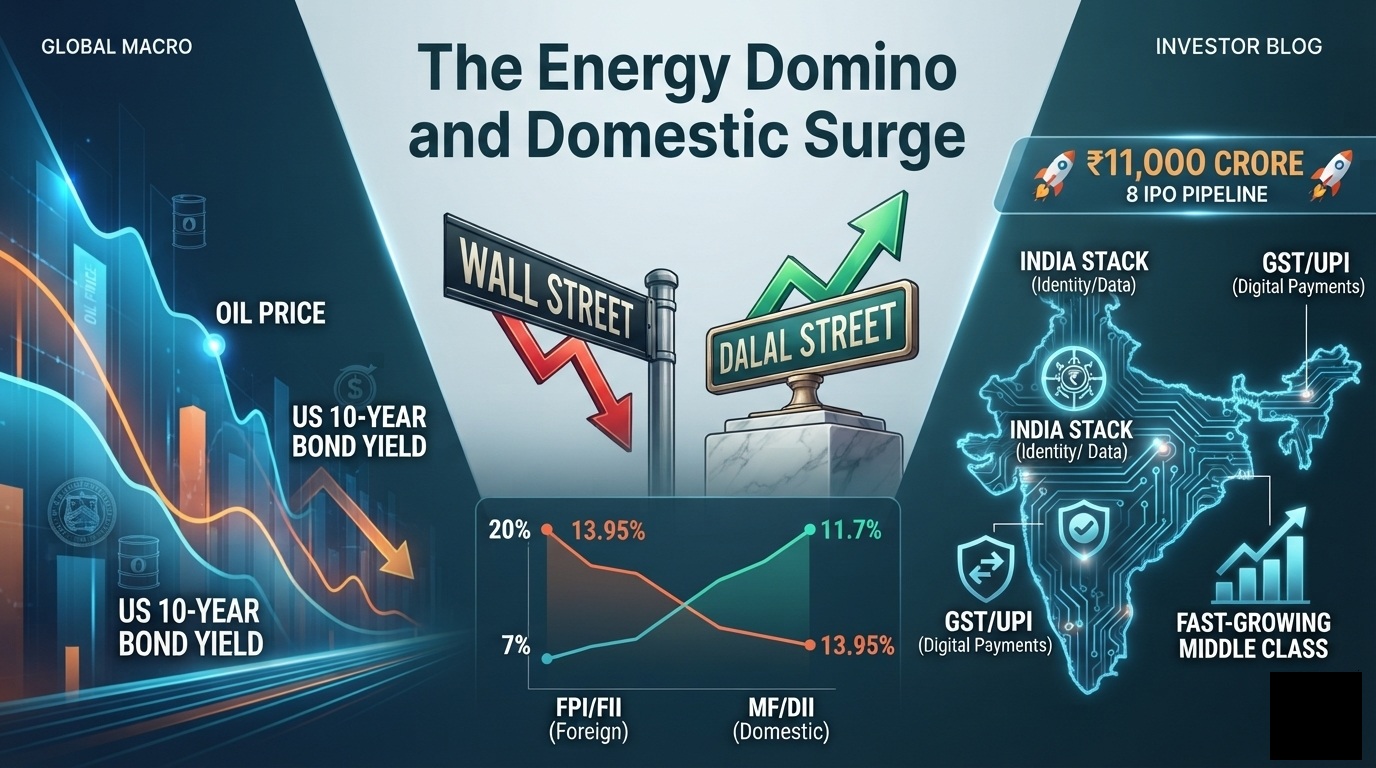
The Foreign Investors Pull Back: Because of global worries about risks the share of foreign investors in Indian stocks has dropped a lot from a high of 20% in May 2021 to below 16% (now at 13.95% in September).
The Local Investors Grow: Because of a lot of money from people coming in through regular investment plans mutual funds have closed the gap to a very low level of 200 basis points…
The Ability to Take in Sales: Foreign investors are selling a lot; local investors are taking in these sales easily…
EQUITY OWNERSHIP SHIFT (May 2021 vs. September)
FPI Share: [20.0%] ➔➔➔➔➔➔➔➔ [13.95%] ( low)
MF Share: [7.21%] ➔➔➔➔➔➔➔➔ [11.70%] ( high)
Phase 3: The Currency Protection and World Tension
Even though Dalal Street has become strong the overall health of India depends a lot on how India keeps its money in balance amid global trade uncertainty.
The Big Money Protection
Even though there are worries about money going out of the country the Rupee has not been very weak. Global banks still believe in India’s economy. Tan Su Shan, the CEO of DBS Bank says India has economic defenses.
The FCNR Success: India has raised a lot of money through the FCNR(B) program showing that foreigners still have long-term trust in India’s economy and ability to handle debt.
Big Growth Parts: India has parts like its public systems (India Stack, GST, UPI) a growing tech scene and a fast-growing middle class. All this makes India one of the places for investors around the world.
The Main Job: To stop shocks from oil and bond rates India is working hard to bring in long-term foreign investment and grow exports so the Rupee has a lasting support.
The World Tension (The New Foreign Investor Problem)
Even though cheaper Russian energy helps India’s money balance and keeps the Rupee from falling global money still has a world problem.
Laws like the U.S. Lindsey O. Graham Act threaten trade problems or extra punishments on countries that don’t follow its rules. International money managers now have to add a risk cost to their calculations.
This problem causes a short-term split: local money is buying the India growth story hard while foreign money is being careful because of the risk.
Phase 4: The New Company Launch (IPO Pipeline)
The sign that India’s money inside is still strong when the world is changing is the strong state of India’s first market.
While the second market sees selling the first market is ready for a lot of money.
Eight new company launches are coming out in one week aiming to collect ₹11,000 crore
The Big Companies: deals led by Zetwerk Manufacturing—India’s biggest of the week raising ₹5,000 crore from an issue and offer for sale—plus HD Fire Protect, Fusion CX, Bonfiglioli Transmissions and Sahajanand Medical Tech show plans to grow.
The Small Companies: small growing companies like Ravita Engineering Services and Vaibhav Vyapaar are getting attention from investors and people with a lot of money.
This big list shows that India’s companies are still spending and looking for investment even when foreign investors are nervous.
3. Historical Valuation: The Earnings Catch-Up Zone
The ultimate proof that India is in a structural growth phase—rather than a speculative bubble—lies in its current market valuation. Following recent global macro corrections, the Nifty 50 trades at a trailing P/E ratio of 19.41 and a highly attractive 1-year forward P/E of approximately 16.2x.
Historically Cheaper: A trailing multiple below 20x places the index 12% below its 5-year historical median of 21.95, signaling an institutional "buying zone."
The Earnings Shield: This valuation compression wasn't caused by weak corporate performance. Instead, robust 12.3% annualized corporate earnings growth has caught up with index prices. With forward EPS growth projected at 18% for FY27, Dalal Street's current valuation offers global and domestic investors a deep margin of safety.
The Bottom Line for People Who Invest
The idea of the Energy Domino shows that big supply issues still control inflation and bond rate paths. For Wall Street lower energy prices mean bond rates will eventually go down.
For Dalal Street the situation has changed a lot. India is no longer at the mercy of foreign money leaving. With money from mutual funds strong growth that global banks trust and a strong ₹11,000 crore IPO list the Indian stock market has built a strong local wall.
The Investment Plan: Be ready for short-term ups and downs as foreign investors adjust to risk and high U.S. Money problems. Take advantage of dips in the market to buy Indian stocks because the shift, from foreign, to local ownership gives the market a strong long-term base.